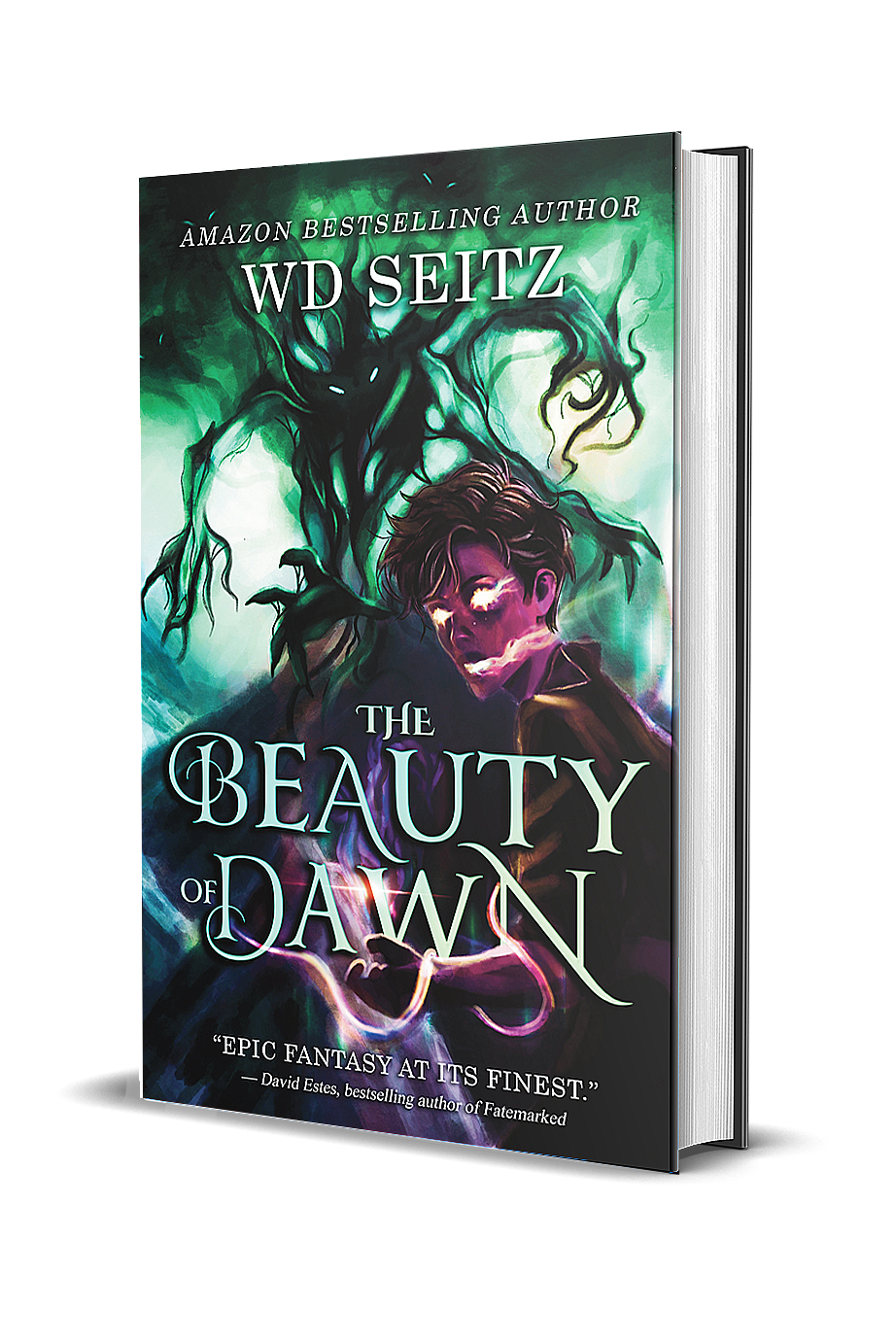
The Beauty of Dawn - Sample Chapters
1. Emmett’s Oath
In the plains of Arden, there was a small farmhouse crosshatched with brick, nestled in a thicket of dead garden plants. Smoke plumed from the chimney, spiralling up into a blackened sky. The bottom step of the front door had collapsed, and the windowsills had splintered dangerously. In the yard, a rusty wheelbarrow was kissed with frost. The wheels had seized and it could no longer move. A smell lurked in the fields beyond the house—one of cold rot, like a callous, festering ice-burn. It was the stench of a world dying. It was an eternal decay.
Audric Lucian, a knight of the Faith of Auyn, had built this house from the ground up. He was large and towered over the rest of his family, particularly his son, a paper-thin boy who often ran out of breath going up the stairs. Audric was a soldier, something anyone could determine by looking at the crop of his blond, ash-coloured hair. Life at home could be fairly militarized—he wasn’t one to leave work at the workplace. Today was no exception.
Audric glanced at the wall, where a series of carved wooden plaques hung, displaying his greatest victories. After breakfast, he always tasked his son with dusting and polishing them. Then, depending on the day, he would take the two-hour commute on horseback to the Faith of Auyn, where he trained vigorously in the art of combat. Sometimes he hosted seminars for the pages and squires, or held specific classes that focused on grappling or weapon arts. But mostly he sat in the wardroom, boasting about his most recent kill. That was what the plaques were for—they represented every time Audric saved a town or city from the Shadows of Twilight. The deadly wraiths that plagued Ealidor, dousing the world in their darkness.
He would come home to find Emmett Lucian huddled up on the couch with his mother. That evening, he wandered through the door, discovering the two of them asleep. His wife stirred as he entered and began softly stroking Emmett’s hair. Audric fought the urge to interrupt them. He didn’t like seeing Emmett so small, weak and vulnerable. His first instinct was to put the boy to work. Have him pour grain into the silo for a couple hours, or break a couple chicken necks—something that would build up his muscles and maybe even induce a growth spurt. Sleepy children didn’t live long in the Dark Ages. Emmett needed to be strong if he was going to survive.
Audric gently shook Emmett’s shoulder while his wife glared at him. “Hey, kid,” he whispered as Emmett opened his eyes. “It’s bath time.”
“You’re home!” Emmett leapt into Audric’s arms, while Audric cleared his throat and patted Emmett’s back. After a moment, Audric gently pushed the boy in the direction of the privy. Baths were a rare luxury in Ealidor; the water had to first be heated in kettles by the fireplace, then drained into a knee-height wooden tub. Audric had noticed the kettles as he walked in, and he breathed a sigh of relief, knowing it was a wash day. Emmett’s hair was slick enough to grease a pan, and his face was so dirty, Audric made him put up his hood while out in public. He couldn’t have anyone thinking his son was a beggar.
Audric stared into the hearth, where charcoal splattered over concrete. His wife was trying to start a fire, kneeling on the wooden floor in a dirty gown, a sweep of dull hair hiding her face. She didn’t ask him for help. It wasn’t something she was known for doing. The coal bed refused to catch, yet he offered no assistance. There was something else on his mind.
A loud bump sounded from the hallway. Emmett emerged, his hair slightly damp, a rag pressed against the side of his soft face. Not looking Audric in the eye, he appeared almost bashful. “Hit my knee getting out of the tub.” Sure enough, Emmett favoured his right leg, rubbing his thigh with the heel of his palm. Audric sighed and stood from the armchair, which had been recently waxed. Their whole house was like that—as spotless and pristine as the Faith of Auyn’s barracks. So how was it that Emmett persisted in hurting himself ?
“Sit down. I have to talk to you.” Audric motioned to the chair, where the dust was elevated and hung gently in the air. Emmett obeyed, bringing his legs up beneath him. “No, sit properly. This is important.” The boy shifted his position.
For a moment, Audric listened to the wind rattling the windowpane. The item in his pocket seemed to press against his chest, an immense weight that suffocated him. There was time to catch his breath, then Audric retrieved the pendant and placed it faceup in the palm of his hand. “This belonged to my father, passed down from my father’s father, coming from a line of fathers before him. All of them were knights, and they fought bravely, protecting Ealidor from the darkness that plagues us. They wore this seal—our family’s seal—on their breastplate.” Audric touched the pendant to Emmett’s chest. “Right above their heart.”
Emmett gently parted his lips. The pendant shimmered in the firelight. Inscribed on the silver crest was a bear, climbing a shield that bore the Eldian flag. It was a promise. The Lucians were bound to serve and protect Ealidor, but Audric wanted Emmett to know that he would always be there to protect him, too.
“Now, you’re too young to be wearing such heavy armour, and you’re certainly a few years away from becoming a knight. So I made it into something that would fit around your neck.” Releasing the string, Audric gave the silver pendant to his son. “It’s yours now, Emmett. Guard it well.”
“Yes, Father.” Emmett fingered the engravings, a slight blush on his cheekbones from the cold. “I will keep it forever.”
2. Once a Thief
When an Eldian child took their first breath, it was said that the Candlemaker—a man-like machine made of wax—ignited their flame. Some children claimed they could taste the fire in their mouth upon birth, popping on their tongue and burning their nostrils. The Candlemaker then stored their candle, their life force, inside a compartment within its chest where an ordinary man’s heart would be. The compartment was endless, an entirely new dimension of shelves, all of them lit up like dazzling fairy lights. Nathaniel Kade, a street boy of fourteen, sometimes thought he could remember the fire.
The inn stuck out like a sore thumb, paining the side of the road, angled crookedly against the rest of the buildings. Mounted to the chimney was the decapitated head of a scarecrow, wearing a cheap, bedazzled iron crown. The King’s Head was one of the only taverns in Ealidor that openly mocked King Edward Falkon. It was also a popular hunting ground among thieves. Gulls as black as soot hopped along the overhanging rim of the roof, gawking at a moonless sky. Loud, drunken laughter echoed in the settling fog of the road where Nathaniel stood, watching the door.
A man opened it, chuckling to himself and rubbing one hazy green eye with the back of his hand. The hands themselves were scarred and dirty, like they had dug one too many graves. Resting loosely at his hips were a pair of identical dual scimitars. His muscles had been coerced into a short-sleeved shirt, and sweat misted his forehead, where ash-blond hair stuck to his skin. His large, brawny build made Nathaniel suspect he had some distant Perhdan descent, which meant he was probably a soldier—most Eldians were small, impish and scraggly, unfit for war. Pinned to his chest was a silver brooch that sparkled in the lantern light: an elaborate coat of arms. A knight of the Faith, Nathaniel thought, grimacing. Knights of the Faith of Auyn were pledged by blood to protect Ealidor from the darkness. Their family seals were their uniform, derived from rare materials like iron, silver or gold. Nathaniel’s gaze settled on the hunk of metal clipped to the knight’s leather-hide jacket. What kind of idiot displayed something that valuable so proudly? This would be easy.
Throwing a grey hood over his face, Nathaniel took to the shadows. The dark had always been a friend of his, so to speak. It was there when nobody else was, and there was nobody else. The steps creaked solemnly as the man descended them, ghosting the dark stubble beneath his chin with his palm as he mumbled absently to himself. He turned up the street, settling his gaze on the shadowed citadel.
Nathaniel approached from behind, his leather boots making no sound as they padded across the cobblestone. He bumped into the man, swiping the silver brooch and taking a casual turn up the stairs to the inn. The man gripped Nathaniel’s arm—a lightning-quick movement, faster than any sword Nathaniel had ever seen swung—and held tight.
“Drop it, boy,” the knight said, and those green eyes, though rather plain, like the bottom of a forest bed, made Nathaniel’s fingers unravel. The crest dropped to the ground. “You’re young.” He let go. “How long you been out here, living like this?”
Nathaniel mutely avoided the man’s gaze, pulling the lip of his hood farther down over his face. Audric Lucian knelt to retrieve the brooch. When he stood again, the boy was gone.
***
In Ladoria, whenever it rained, the water gathered up all the muck in the city. It flowed downhill to the lowest residence, gathering in the storm drains, where it became a soupy brown colour. Anyone who happened to walk by might see the substance oozing from a set of pipes and, feeling sick to their stomach, look in the other direction. This was what Nathaniel Kade called home. Some of the lines were backed up with so much old gunk that they imitated a blocked artery, preventing the water from flowing, creating a rare dry haven to sleep in. For the homeless, it was as good a place as any.
Nathaniel had lived in the pipes since he was five years old. He remembered it being more comfortable back then, when he could stretch out his legs all the way and sleep. Now Nathaniel was bigger and had to bring his knees to his chest to fit properly. If he were smart, he would move on, but the storm drains were familiar. He knew the pipes would never suddenly turn on him or kick him to the curb. They would always be there to welcome him home.
Nothing much decorated the pipe. There was a dirty old towel meant to provide some cushion against the hard concrete—sometimes it was used as a pillow. In the corner, a container for eating, if he ever got the chance. There was also a wet newspaper, smeared and illegible. Not that it mattered; Nathaniel was illiterate.
Thinking about the newspaper reminded Nathaniel of the dog. It was beyond dead, lying in a ditch not too far from the pipes. He unfolded his legs, aching slightly. Hunger wasn’t something that just ravaged your stomach; it destroyed your entire body. When he made for the ditch, he nearly collapsed into it, dropping to his knees.
The dog was upside down and broken like a string puppet. Its legs were frozen in rigor mortis, splayed out before him as icicles. A swarm of flies had taken to the lining of its stomach, where they buried themselves in a new home. Ealidor was a country where one suffered even after death. The carcass was half-covered in rocks, which had been Nathaniel’s doing. He was not being sympathetic. He simply wanted the thing gone. Every time he saw its face—placid, staring at nothing—he saw himself.
There was a large rock shaped like a spearhead. He pushed it into the ditch, crushing the dog’s head. There would be no more suffering for anyone.
***
It was raining harder than ever before. Nathaniel was begging on the street when it started, then recoiled into the shelter of an alley—but it was too late. The storm had drenched him. He leaned against the outer wall of a house, shivering. Water slipped from the roof and fell before his eyes hypnotically, over and over again. A window emitted a column of frail light. The town was vacant and the thief could hear nothing over the steady roar of the sky, which was black with rain and something else.
Nathaniel wrung out the water from his shirt, his hands trembling. He cursed silently at himself. Stupid, he thought, baring his teeth. Surviving as he did, wet clothes meant more than simply hanging them up to dry. They were his only clothes, and now they were freezing. He should have sought shelter the moment he heard the thunder breaking on the horizon. Not only that, but there was a weakness in his body Nathaniel couldn’t ignore. Given the opportunity, sickness would set in. He hoped the alley was clean. There were no plagues he knew about, so that was good—not the typical ones, anyway.
A shadow passed over the window. Nathaniel froze, but it was only a mother, tucking her child into bed. Nathaniel rested his head against the screen to listen more closely. The mother murmured something, but he could scarcely hear her through the downpour. Then she started to sing, but it sounded more like a hum, and Nathaniel closed his eyes. For a few moments, Nathaniel allowed himself to be the child in the window. The woman was singing to him as he lay in his dry cot, the blankets tucked up beneath his chin, and the rain was not treacherous; it was soothing.
Almost too soon, the window darkened, and the woman fell to silence. Nathaniel lay back against the cobblestone and felt a coldness in his chest that seemed to dull his hunger. Rats scurried in the garbage and darted across the alley. Wondering if he would wake up at all, Nathaniel passed into a dangerous sleep.
***
In the Dark Ages, morning never came. Sunlight was an idea, the remnants of a forgotten past. Upon looking up, a person could see churning ebony clouds, gurgling with black thunder. In the beginning, all mankind did was look at the sky. It was a surreal feeling, losing something so vast, so constant. The stars were replaced with the space between them. The children would never know anything more than the darkness they were cast unto. Audric Lucian had been one of those children. Sure, he heard the stories. But after hundreds of years of darkness, they felt more like fairy tales, and it was difficult to believe them. Emmett was different—he listened to every legend, believed in every account, treasuring Ealidor’s forgotten history in his heart. That was how he died.
Audric slammed down the drink. He went over his limit—he thought of his son. Swearing groggily to himself, he left the tavern.
It was the day after the storm. The street smelled like earth; an after-mist of rain still hung in the air, clinging to his skin like sweat. Ladoria was an overwhelmingly quiet town. The houses were shadowy, the windows boarded, and the doors locked twice. Everywhere Audric went, he was watched by somebody. Even as he descended the steps to the tavern, he felt eyes on the back of his neck. He remembered the thief and supposed the town had good reason. The sooner the Faith of Auyn posted him out of here, the better.
“You’ve got some nerve, bloody hell.” Audric looked up the street.
“I’m gonna cave your face in.”
Well now, Audric thought distantly, it’s the thief again. And the little bastard was getting beaten half to death. It was an older man—someone Audric recognized from the tavern, from only a few hours before. His name was Gerold, and they had been gambling together, if Audric remembered correctly. Gerold was buzzed out of his mind. His eyes were bloodshot, and his nose burned red. Audric stood back for a moment to watch it play out. Only when the kid started coughing viciously, like something was deeply wrong, did Audric frown and realize the reality of the situation.
“Alright, I think he’s had enough.” Audric approached the scene and pushed Gerold back a step.
“I’m not leaving until I have what’s mine.” Gerold spat. There was something in the thief ’s hand. Still coughing, the boy couldn’t resist Audric taking the wallet from him. Gerold took the wallet from Audric, shoved it in his back pocket, then kicked the thief in the stomach.
Audric unsheathed his right scimitar halfway, thrusting the hilt into Gerold’s middle and knocking him to the ground. “It’s over. Get out of here.”
Gerold scrambled to his feet and ran. When the man had fled a good enough distance, Audric stepped away from the thief. He didn’t get up right away. That last kick had stolen the air from his lungs; the boy bent over the cobblestone, panting and squeezing his stomach.
Silence owned the town once more. They were the only people in the street. An oil lamp burned on the stoop of the tavern, a gentle light that made shadows waver. Shadows were a dangerous thing in Ealidor. Anything could be hiding inside them—and there was a possibility they weren’t truly shadows at all. When the thief still hadn’t risen to his feet, Audric sighed and offered a hand.
“What’s your name, anyway?” Audric asked. The thief shoved him away and stood on his own. Blood trickled from the corner of his mouth. His face was ashen, and his breath was shallow.
“Nathaniel,” he rasped, then turned away. “Just leave me alone.”
Audric stared up the street, where he thought he saw the drunk again, lurking between buildings. There had been no reason to get involved, and there was no reason to stay. Realistically, he should leave the kid alone. He found that he couldn’t. “You know, I want to,” Audric said, reaching into his coin pouch. From it, he pulled out a single erde and curled it into the boy’s palm. “I seem to be missing some money, though, and I’m not leaving until I get it back.”
The erde glowed a pale white under the blazing streetlamps, and Audric could see the ghostly face of King Athalos Falkon, the first king of Ealidor, scowling up at him from the centre of Nathaniel’s palm. Nathaniel pocketed the dollar. “Thanks. It’ll get me a nice ale.”
Audric narrowed his eyes. “You do know ale is expensive. Besides, you’re a boy. You ain’t buyin’ any alcohol under my watch.”
“Whose watch, sorry?”
“Mine.” Audric grabbed him by the collar of his cloak, his meaty fingers digging into the back of the boy’s neck. “We’re going to sit you down at a table and get you something to eat. Not to drink, to eat.”
“This is stupid. Let go of me!” Nathaniel grimaced as Audric pushed him along. When the door opened, the stench of beer was strong enough to make Audric’s eyes sting. There was no music, and nobody would have heard it even if there was. People yelled drunkenly at the top of their lungs; half-dressed teenagers ogled at each other while pressed up against the window. A thin man with a dagger-like brow was trying to con the drunkest of the lot into giving him money. Audric settled the boy in a corner booth.
“Stay here while I order,” he said, disappearing into a mob of sweating, red faces. He reappeared minutes later, holding two wooden bowls in the crook of his arm.
“Back again, Audric?” someone called from a few tables away.
“Sure am.” Audric dropped one bowl in front of Nathaniel and took the seat across from him, positioning himself a little more to the left, so they weren’t facing each other. He dropped his leather coat on the table, the silver brooch poking out of his pocket. Nathaniel watched him for a while before starting his meal. Audric ordered two portions of cooked carrot soup, the week’s specialty. The moment the thief saw it, his eyes glassed over. He took one bite, which led to another, and another—until finally, the bowl contained nothing but a wooden spoon. Audric looked down at his own meal, which he had not touched. “You know, you don’t look so good, kid.”
The boy folded his hands in his lap as if he were contemplating what to say. Audric waited, but he didn’t say anything at all.
“Did you like the food?” Audric tried to peer under Nathaniel’s hood, but the boy hid his face. Audric glared and leaned forward over his knees. “Hey, are you listening to me?”
Nathaniel peered sideways at him, his grey eyes glittering. “Yes, it was delicious.” Then he doubled over, squeezing his stomach. Nathaniel groaned, knocking the bowl from the table as he covered his mouth with his other hand. “I think—I think I’ve been poisoned.” He panted, tears budding in the corners of his eyes. “Someone help! This man has poisoned me!”
Audric glanced around himself. The mates he was previously drinking with didn’t seem to be there anymore, and Nathaniel was starting to draw the attention of the people sitting at the bar. One of them placed a hand on the hilt of their sword, deliberately lowering their gaze at Audric.
“Stop this,” Audric hissed at Nathaniel. The boy smiled and rubbed his fingers together, holding out his hand beneath the table.
“Oh, I’m going to be sick…” Nathaniel wailed. Audric scoffed. He pulled out his wallet and slipped a single erde into Nathaniel’s palm.
“How could you do this? I trusted you!” Nathaniel cried. Wasn’t he overdoing it a bit? Audric sorted the money in his hand, gritting his teeth. He shoved five more erde at Nathaniel.
Just as the boy curled his fingers around the money, the front door burst open. There was something in the way it slammed, the urgency, that made heads turn and gazes freeze. And the face of the man, standing beneath the low arch of the doorway, silenced the entire building. It was white, like a valley of snow. He uttered two words.
“It’s here.”
***
Women were screaming. The bartender dropped the bottle he was holding, which shattered to the floor, and took shelter beneath the counter. The man shut the door gently, his eyes wide, and waved his arms in a quick sweeping motion.
“Shh! Quiet, you halfwits!” He looked to the door he had closed, biting his lip. The door heaved.
Then it groaned off its hinges and flattened the man. There was a crunching noise, followed by a popping; blood and flesh sprayed the counter, the walls, and anyone standing too close. Audric threw Nathaniel beneath the table with such force he had to roll. Nathaniel couldn’t see much from down there, nothing except feet—running for the windows, the back rooms, any form of escape. Someone was even lifted off the ground, he saw, and seemed to have been flung. When the tavern finally grew quiet, Nathaniel slowly picked himself up from the ground.
Audric stood at the head of the table, showered in remains, holding his scimitar in one clenched hand. “Still alive, kid?” he asked, out of breath, and Nathaniel grabbed Audric’s brooch from the table. Audric shouted after him, but he was already gone. Corpses littered the roadside, all variously dismembered. Someone had almost reached the indoors, their arm still attached to the door handle—but that was all that was attached. The rest of the body lay in shreds, painting a set of concrete stairs. Looking to his left, Nathaniel could see the roasted carcass of a man. Upon closer inspection, he realized it was the drunk that had assaulted him earlier. The entire body was in savage flame. A torch lay on the ground beside him, as if he had tried to protect himself with it, as if fire could save him from the wraiths. Nathaniel frowned; attacks like this happened often in Ealidor, but he hadn’t seen one this violent in quite a long time. The sight of the blood, guts, and bodies made his stomach cramp.
Gulping down something hard in his throat, possibly bile, Nathaniel began to walk toward the citadel. It was an odd sort of quiet, the kind of quiet that shouldn’t be there. Silence wasn’t something that sounded in the heat of death; it was something that followed it. Where was the shrieking that had taken place at the inn? There wasn’t even the crackling of torches—the darkness had doused them all.
He thought about the man, and what he had done for Nathaniel. The knight wasn’t the only person to show him kindness. There had been others, empaths who took pity on his soul and gave him shelter, dinner, or money. It always ended the same way. They abandoned him—offered a taste of happiness, and then tossed him back out onto the street. Because he was difficult, because he had no manners, he was talentless, he was secretive, and he had nothing to give in return. Nathaniel looked just like the dog to that man. Something to rescue, until he realized Nathaniel was diseased. Suddenly the thief would mean nothing, and soon he would be discarded.
There had been another knight. Ambrose. The memory of his face was seared into Nathaniel’s brain: ragged, with eyes like dirty rainwater and a topknot Nathaniel found amusing. When Ambrose found Nathaniel shivering in the storm drains, Nathaniel thought he would never see Ladoria again. He had been younger then, recently orphaned. Ambrose took one look at Nathaniel’s ragged, ailing form, and promised the boy he would take care of him.
They lived together at the King’s Head, in the apartments upstairs. Ambrose spoon-fed Nathaniel stories of the Faith of Auyn: a sanctuary on the coast of Arden, a place where whelps were transformed into missionaries for the Goddess of Time. Ambrose would convince the Faith to take Nathaniel in. They would lie, and pretend Nathaniel was his son.
Once Ambrose’s occupation in Ladoria was over, the King’s Head hosted a party to celebrate. Nathaniel sat on Ambrose’s lap as he tried alcohol for the first time. It was sour and disgusting—Nathaniel spewed it all over Ambrose, and the knight frowned, taking the drink away. After that, Nathaniel consumed as much ale as he could, desperate to impress him.
The rest of the night was a blur. Nathaniel still couldn’t remember most of it. There was only one thing he could picture clearly: accidentally dropping Ambrose’s sword off the balcony, watching as the blade was bent in half by the wheels of an incoming caravan. Ambrose had lost his mind on Nathaniel, striking him squarely in the jaw. Then, darkness.
When he woke, Ambrose was gone. He never came back.
Nathaniel’s eyes fell to the cobblestone, damp with late rain. Audric had chosen cooked carrot soup, of all things, to give Nathaniel. That was his favourite meal. The butter, the melting in his mouth—the scent of it drove him mad. His mother would make it for him, whenever the nightmares came. If Nathaniel asked, she would get up to make cooked carrot soup, no matter the hour. That was one of the only things he could remember about her.
From the northeastern wing of the citadel, five soldiers emerged. They carried themselves like royalty, crossing the square and barking orders at one another. Nathaniel peered closer at them and saw Audric at the head of the group.
Nathaniel pulled the hood of his cloak over his face, then pressed his back against the side of an overturned merchant stand, listening. Audric whispered to the person at his right, then took a bold step forward. The five of them moved in a calculated formation as they crossed the square.
The sky was a crater thundering with darkness. A feeling hung in the air, one of sickness and dread. It was inescapable, that feeling. There was no hiding from it, which was something Nathaniel knew all too well. He also knew what would happen next. The world would become dim with that feeling, and the creatures spawned from the crater in the sky. They were the Shadows of Twilight.
Audric was the first to notice that something was wrong. Nathaniel watched, grimacing, as Audric sliced his palm open. Nathaniel could see the two flaps of flesh splitting apart. Audric’s blood dripped down the edge of the scimitar, speckling to the ground like rainwater. He held the blade before himself, guarding the front of his body.
The knight standing behind Audric suddenly went hurling through the air, screaming, before thudding against the roof of a house. Their body slid down the shingles and then dropped onto a weather vane, which pierced their throat. Audric froze, lowering the scimitar.
The soft, tiny hairs on the back of Nathaniel’s neck stood on end. He leaped over the merchant stand without thinking. In seconds his shoulder collided with Audric, sending the knight barrelling to the ground. Having such a small frame compared to the large, blond-headed brute, it was a wonder he managed to do it successfully. In the place Audric had last stood, a blackened, bone-like scythe mutated in the air and sliced viciously at nothing. There was a sound like scraping metal, and the pavement snapped as the scythe hit it.
“What—” Audric tossed Nathaniel off him. “You?”
“It’s still here,” Nathaniel gasped. “It didn’t leave. It’s still here.” He tilted his head up, his face shadowed by the hood and the sable sky. “All of them are.”
“You can see them?” Audric cried.
From behind, another knight took off in flight. The shades were picking them off one by one. Audric took a defensive stance in front of Nathaniel, and they slowly backed away from the citadel. The darkness thrummed, hungry for their blood. It would not let them go so easily. Nathaniel’s heart pounded when a wraith emerged from the depths of oblivion before Audric. The scythe protruded from the shade’s sleeve, curling around the lower half of its body. Nathaniel swallowed hard as he stared at the weapon: it was made entirely of bone. According to the prophets, the Shadows of Twilight were all once living people, and their scythes were constructed from their skeletons.
Nathaniel stared into the eyes of the wraith. Or at least, tried to. There wasn’t much to look at. The darkness could form the shape of anything, but a Shadow of Twilight’s true form was that of a faceless spectre, hidden by a tattered, ethereal cloak. The skin beneath the hood shifted constantly, drooping and melting—a kaleidoscope of rotten, decaying flesh and muscle, shrouded in shadows.
There wasn’t enough time to run. It had them right where it wanted them. Just as the shade was about to strike, Nathaniel pushed Audric out of the way. The scythe came down at an angle, and the dull side of the weapon hurled Nathaniel across the citadel.
Although dazed, likely injured, and feverish, Nathaniel rose to his feet once more. He sprang at the wraith. The monster writhed in his grip, then vaporized into the night.
***
The darkness receded from the citadel like the swirling of a sink drain. With it, Nathaniel could have sworn he heard a voice, a simple breath in his ear:
My prince.
But it was probably nothing. He was, in fact, a little delirious. The poisoned act he put on earlier wasn’t all that far from the truth.
“My God, kid. What the hell? What the hell.” Audric placed his hands over Nathaniel’s shoulders. They’re warm, Nathaniel thought. It was a pretty stupid thought. “How did you know the darkness would come? That it was still here?” Audric pressed. Nathaniel said nothing. His knees buckled, hitting the cold, damp cobblestone.
“Cripes, you’re pale.” Audric held him upright. “Take it easy, kid. I have you. Take it easy.”
The rest of the knights gathered. They looked around doggedly, expecting something to launch itself out of the shadows. They had nothing to worry about. Nathaniel could feel it—the darkness was gone. Only minutes before, he had been operating on adrenaline. Now that it was over, the sickness plundered his body. He breathed through a blockage of phlegm as the buildings teetered around him, mirages of a spinning citadel. Every movement was a fight. Nathaniel was aware of how pathetic he looked—this was the moment they always left him. His eyes rolled into the back of his head and he passed out in Audric’s arms.
***
“Ambrose, round up the horses,” Audric said, looking over Nathaniel steadily. “We’re bringing this boy back to the sanctuary.”
Ambrose glanced at the child leaning limply against Audric’s chest. “Sir Lucian, you’re not serious. He’s a street rat, a lifter. He’s hopeless.”
“Now!” Audric barked. Ambrose paused a moment longer, his gaze lingering on Nathaniel, then dashed down the road. Against the fabric of his chest, Audric could feel Nathaniel’s laboured breathing. Carefully, he raised him from the sidewalk. Audric wasn’t an idiot. There was a reason why he was so drawn to helping the kid. Maybe if he hadn’t gone one drink over, this wouldn’t have happened. He removed Nathaniel’s hood, revealing a soft face burdened by years of affliction. With his eyes closed, unable to see their colour, the thief looked exactly like Emmett Lucian.
“Rest,” Audric murmured. “I’m taking you to the Faith of Auyn.”
3. Sanctuary
Peter Falkon, the heir to the throne of Ealidor, stared out the window of his tower. He sat hunched over on a moth-eaten canopy mattress, elbows resting on his knees. The mice were at work in the walls, taking the castle slowly apart. Oil paintings of his predecessors bore down from above, varnished with dust and yellowed with age. The tower was circular, dingy, and lacklustre. Peter momentarily closed his eyes and placed his head in his hands. The windowpane creaked open, hitting the shale wall with a sudden gust of wind. He refused to close the window because it was the only sound in the tower, the only action. Without it, the air was bland, and his mind was numb.
After what felt like hours, the maidservant knocked on Peter’s door. His ears pricked at the sound, the foreign click of the lock coming undone. She wandered inside his rooms, her brow raised as her gaze scoured over the mess. After a moment, she crossed the room and leaned out the window to close the pane. Peter stood from the crumpled bedside, eyes suddenly alight after being bleak for so long.
“Don’t close it!” he shouted. “Don’t you dare close it.” His fierce whisper sounded throughout the room, barricaded with books and desks and drawers.
The maidservant bowed, white-faced, and hurried away as quickly as she could, in fear that the young prince might be as ruthless as his father. He watched her go, and as soon as she left, he longed to have her back. To have a reason to shout, to stand from his bed, to have a voice etched with passion.
He listened to the constant creaking and groaning of the pane, and the occasional smack against the shale walls of the castle. A raven, he saw, landed on the sill with a wild flapping and stared at him solemnly. The raven, the bird that walked between worlds—at least that’s what his books told him. He glanced at his collection, piled up in the corner, nearly as tall as the ceiling and spilling over with notes. His gaze drifted past the raven, staring out at the city of Stonegate. He read books on that sill, one leg dangerously hanging off the edge, the other pressed up against the frame.
And sometimes, when the day had been particularly bland, he leaned forward.
Sometimes, both legs dangled off the edge of the tower.
On the rarest of occasions, one foot stood on the sill while the other dared to step off. He would stay like that for a while, one limb midair, the other hanging on not for dear life, but debating it.
Each time, he would cower and retreat from the edge. Something always held him back, but it wasn’t his love for life—it was his hatred for his father. He remembered King Edward Falkon explaining that the prophets of Ealidor summoned the Shadows of Twilight with their dark magic, wreaking havoc on the world and shrouding it in darkness. But Peter knew the truth. He knew why the shades roamed and attacked the city far more than anywhere else, why the royal family was being targeted, and why their castle had fallen into ruin.
The people shared Peter’s disdain for his father; he would see the odd person from his window, spitting at the soldiers that roamed the castle grounds, only to end up in the moat.
Peter tried not to think about what Ealidor thought of him. Years ago, the Library of Celtia had been discovered, ruined and grown over since before the Dark Ages. King Edward Falkon had instructed Peter to burn it to the ground, demanding that every book inside be roasted. The pages, shrivelled and blackened, had flown into the air, scattered across the sky like stars (though Peter struggled with the concept of stars, his understanding of them limited to what he had read. The idea of another world, bound by its own gravity, visible only as a bursting sphere of light to the naked eye, was so absurd to him it seemed fictional.) He could still feel the heat, making his skin blush. Because like any faithful son, Peter had done what his father asked of him and dropped the match.
Now he was done being obedient.
The time had come when he could no longer serve the king.
Peter Falkon stepped up onto the windowsill and judged the distance between him and the moat, which flowed out of the city walls, into the sea, and washed up on the beaches of Arden.
The raven soared overhead.
He held his breath and jumped.
***
Audric Lucian, loyal knight to the Faith of Auyn, was a simple man. At least, he liked to think so. He used to smoke a pipe back in what he called “the good old days,” when things were dandy and sweet, when women stuck love notes in the cork of his rum as they served him, and when his son was still alive. But times weren’t like that anymore. After the death of his son, he broke the pipe habit and now used toothpicks to feed the addiction (a man with a crooked smile he grew to like had taught him that one clever trick).
At first, he’d thought he’d lost everything when Emmett never came back, and his wife left him. He thought all those times he didn’t tip the waitress as well as he could have, all those pages and squires Audric could have trained with more ease, all those people he killed in the sweating, red-faced heat of battle…he thought all of it had caught up to him, and the death of his son was him paying the price. Instead of dealing with his emotions, Audric buried them in alcohol, trying to forget that part of his life ever existed. It had been years since he returned to the farmhouse because he could not return without seeing ghosts.
The Faith of Auyn assigned him to fieldwork as he was no longer capable of teaching. Classes would often deteriorate into screaming matches and bouts of depression. Rafael, the Faith’s general, assumed Audric would expel his anger on the thieves and addicts of Kyrefall, maybe kill a couple Shadows of Twilight and be done with it. It had been fifteen years, however, and Audric still couldn’t heal. He travelled from town to town, following different assignments, doing his general duty of protecting Ealidor from the darkness. That was his purpose, after all, as a knight of the Faith—he was doing God’s work, saving the Goddess of Time’s creations from the unholy creatures in the sky. Auyn—a word in ancient Eldian, said to be the true name of the Goddess. It was noble work. That was what he told himself, anyway. It usually ended with him passing out on the floor of a tavern, getting reported to the Faith, and having to change cities again.
Audric halted before the thief ’s room. He pushed open the door slightly, observing Nathaniel lying on the bed. The sheets were damp and thrown in every direction. His breathing was ragged, his chest wheezing with every exhale. A young religious healer, Lilian, was the only physician who would touch him. The rest feared he might have Nyctophobis and refused aid. She was asleep now, sitting in a chair at his bedside. How was it that Nathaniel could see the Shadows of Twilight? The creatures were naturally invisible—only in the event of a killing blow would they show themselves.
Someone tapped Audric on the shoulder. He turned and was surprised to see Rafael Letholdus, the commander of the Faith. A short man, slightly hunched, he also peered into the thief ’s room.
“Welcome home, Sir Lucian. It’s been quite a while.” His voice was low. He stroked his chin, returning his gaze to Audric. “Do you plan on staying?”
Audric sighed and leaned against the doorframe.
When he’d first grabbed the boy, for a split second, he could have sworn he was holding on to Emmett’s arm. When he looked up, he’d thought he had somehow found his missing child of fifteen years. But there was a rabid fire in the boy, a troublesome infliction that didn’t quite belong to anybody else, including Emmett. The thief was not his son. In a moment of vulnerability, he’d brought a stranger into the sanctuary. He could feel Rafael judging him. He could also feel his pity, and hated him for it.
“No, I’ll be gone by tomorrow.”
“A shame. I have a mission you would be perfect for.”
Audric scoffed. “What is it?”
“It’s a retrieval. There is someone I need safely delivered here.” Rafael looked at Nathaniel again, his gloomy face turning sour. “You’re clearly capable.”
“Alright, but why me? I’m the last person you should be asking.” Audric rubbed his own arm. He knew what the Faith thought of him.
“That’s exactly why you’re perfect for the job. This individual is…high profile. Nobody would expect you to be the one to retrieve him.” Rafael lowered his gaze at Audric. “You’ve been marring our reputation for the past ten years, Lucian. Think of this as your chance to regain some honour.”
“Enough.” Audric, feeling jittery, stuck a toothpick in his mouth and crossed his arms. “I’ll do it. Beats the tavern, I suppose.”
“Well, there’s something I didn’t expect.” Rafael gave him a single, solid pat on the shoulder. “Come see me in my office and I’ll give you the details.”
“Yeah, sure.”
“And when you do leave, take that boy with you.”
Audric raised his voice just a little too loudly. “What?”
“Well, we can’t have him stay here, obviously. That is, if he survives whatever is ailing him. Take him with you and leave him on the road somewhere.”
Rafael sounded cruel, but deep down, Audric knew he was right. Nathaniel could not stay at the sanctuary. Only a descendent of Auyn, whose parents or grandparents were enrolled, was allowed entry. It was a tradition lasting for generations—it kept the sanctuary and its secrets safe. Audric closed his eyes momentarily. It wasn’t like he knew the kid. He’d done all he could, given the circumstances. That counted for something.
“Alright.”
“Good man.” Rafael smiled vaguely and then left Audric to his thoughts. After lingering for a moment, Audric gently closed the door to Nathaniel’s room.
***
For as long as he could remember, Nathaniel suffered from nightmares. Black, ghostly things that tugged at his clothing and circled his ankles, whispering strange words he couldn’t understand. Nathaniel would wake up wholly tormented, his heart racing in his chest, blood pounding in his ears. And a peculiar sensation—one of anxiety, as if he were somewhere he shouldn’t be.
That was what he felt upon coming to consciousness. He expected to be in the pipes or beneath the overhanging lip of a sewer gate. Instead, his eyes opened to a white marble ceiling. He was lying in a comfortable bed, with pale sheets and soft linen. The expansive room was lit only by the glare of a window on the far wall. Through that window was a short gate, and beyond that, the plains of Arden. They were shadowed by towering mountains and iced-over glaciers, encased in a spiderweb of waxen snow.
Grimacing, Nathaniel swung one leg over the side of the bed and then the other. Suddenly overcome with dizziness, he had to pause. How long had he been out? He realized he wasn’t wearing a shirt, and someone had replaced his wet clothes with dry ones. The thought of somebody touching his bare skin without him knowing sent him reeling. He had been entirely at their mercy. He found that with great determination, he could stand, but walking was a whole other ordeal. The creaking floor sounded like the breaking of bones as he crossed it. With every step, his legs wobbled dangerously. He fell on top of a dresser and took long, sucking inhales to steady the pain.
There was a mirror smudged with old fingerprints and worn with scrapes. Nathaniel glanced at his reflection, grimacing. His eyes, now bloodshot, were a calm sort of grey, like the settling mist around the cape of a mountain or the sky before it thundered. His lashes were dark and thick, shadowing his gaze, making it seem lost and far. Wandering, his mother used to say. His hair appeared black at first glance, but in the right light it was actually a dark brown, the colour of burnt chestnuts. His cloak, which he had seen draped over a chair earlier, made him look bigger. In reality, he was thin and small for his age. Ten years on the road were to thank for the lack of good and healthy fat. His belly seemed actually to reverse into itself, his skin pale and malnourished. He couldn’t remember the last proper meal he ate, and quite often, his stomach spoke to him more than people did. Nathaniel was a street rat wholeheartedly. He looked like a thief, like he slept in the dirt and got more welts than he could count.
He managed to turn himself around. Leaning heavily on the dresser, he scanned the room. He knew he shouldn’t leave yet; the sickness was still weighing down his chest, sloshing about in his lungs. But the more time he spent in this place, the more he wanted to get out. He searched for his bag, but the room was empty of almost everything.
Nathaniel pushed himself upright and tried the door.
***
It opened, but not by his hand. Standing in the doorway and towering over him was a stout woman, her shoulders built up in plates of armour. Her face was handsome, though her lips were pursed together in a dissatisfied frown. Her hair was brown, thick, and tied behind her head so tight it seemed to pull the skin back from her face. She went to say something, but Nathaniel pushed past her. He ran down the hall, stumbling into walls and fighting the spinning in his head.
“Wait!” she yelled. “Stop! I’m not going to hurt you!”
Nathaniel wouldn’t stop. He knew that expression—full of wrath and disgust. She’d probably come in there to beat him. He didn’t know if he could survive a beating right now. The floor shifted with every stride. Turning a corner, he dove through an open window. The ground came up to meet him, harder than expected. He lay there for several moments, staring at the darkness in the sky, waiting for his body to catch up. Long before he was ready to move again, the woman shoved her head out the window and reached for him. He rolled out of the way, forcing himself to get up. Legs pumping, he moved across the field, stealing glances behind. The woman tried to fit herself through the window but couldn’t, and disappeared behind the frame. Nathaniel, running backwards, slammed into someone.
“Watch it!” called out a voice. Nathaniel moaned from the ground, holding his head in his hands. When he looked up, a girl was standing there, grasping a sack of oats. Half the bag had spilled over. She tried to scoop a handful back inside, but too much had escaped. Sighing, she glared down at him. “Hey, wait, are you alright?”
“I have to get out of here,” Nathaniel pleaded. “Someone is after me.”
“I don’t recognize you.”
Nathaniel shakily rose to his feet. “Come on,” he urged. “Just find me somewhere I can rest for a second.Then I’ll get out of your hair.”
She looked him over. “Okay, but you have to help carry the oats. You made me rip a hole in the side. Cover it up for me.”
Nathaniel did what she asked, his brow twitching. Despite the bag’s weight, she was quick on her feet, and they made it to the stables before the woman entered the field or saw them.
The stables smelled, but not as profoundly as the ones in Ladoria. The stables themselves had to be at least fifty years old, the wood scratched and crooked, sticking out in disproportionate directions. It was mostly dark inside, spare a lantern hanging off the far wall that gave a deep orange glow, making the hay seem like it was sparking with embers. The horses were quiet and only stared at them as they entered, blinking and swatting flies from their hindquarters. The girl set down the bag of oats, and Nathaniel fell against a mound of hay. He closed his eyes, trying to stop the pounding in his head.
“I know who you are,” the girl said. “You’re who they brought in a few days ago. You saved Sir Lucian from a shade attack.” She paused, then added quietly, “they’re saying you have Nyctophobis.”
Nathaniel only stared at her. Her hair, a honey-like hazel colour, was long enough to reach her waist, though she kept it in a single braid. A small number of freckles sprinkled her nose. Her deep brown eyes turned up softly at the corners; she had a face unhardened, though skeptical and full of uncertainty. She might have been Ailish given her glossy, golden-brown skin tone. He felt as if he were staring through thick glass, watching a dream.
She slid down the gate of the pen, taking a seat across from him. “It looks like you just have pneumonia, though.”
Nathaniel shrugged, casting his eyes to the ground. It wasn’t often he talked to someone his age. There were scarcely any children in Ladoria.
“Well, you’ll be safe here for a while. The horses don’t need to be fed again until the evening, and it’s only me who checks on them.” The girl glanced at the entrance, where the wind started to pick up. “Who were you running from?”
Nathaniel found he didn’t have the energy to explain, so instead, he closed his eyes and rested his head against his knees. The girl raised herself from the ground and began to dump the oats into the troughs. He learned that her name was Cassidy, as she told him unprompted and during a prolonged silence. She had a strong physique, well-toned and muscular. Her cheeks were not hollow with starvation, as his were—they were pink and fleshed out. The contrast between them made Nathaniel hyper aware of himself, and he frowned.
“So,” he started, rubbing the back of his neck. “You’re the stablehand?”
“No.” She laughed. “My father is, though, and I feel obligated. I’m a squire under Lady Aldaine.”
He nodded as if he knew what she was talking about. Feeling the warm glow of the lantern and listening to the wind rustling in the eaves, Nathaniel laid his head against the hay pile, eyes half-closed. The back of his neck glimmered with perspiration. He wouldn’t have survived this sickness if it had not been for the knight. That was something he was sure of. There had been a weakness in his body, a frightening sensation of letting go and giving up. It wasn’t worth the fight, and frankly, he no longer had the will for it.
Eventually time slipped away, the stables’ entrance becoming considerably darker. Nathaniel woke with a start an hour later, clutching his sleeve, his heart pounding in his ears. How could he have let himself fall asleep? Once again, he’d allowed himself to be vulnerable. Nathaniel bit his cheek, fighting the urge to smack himself. Cassidy was still there, a mare’s muzzle pressed against her palm. She stroked its mane haphazardly. It looked like she had started a braid, then stopped. There was something on her mind. Nathaniel considered asking her what it was, then thought better of it.
“I wanted to ask.” Cassidy turned around, completely stoic. “What’s Ladoria like?” Nathaniel blinked. “You’ve never been to Ladoria?”
“I’ve never been outside the Faith of Auyn. My mother forbids it. I’m allowed on the hunting parties, though. Sometimes Sir Rythen will take me to the river or the woodlands, and we’ll set traps for rabbits or track down elk.” She started to unwind the braid in the horse’s hair, working meticulously at it with her fingers.
“Wait—” Nathaniel glanced outside the stables. “This is the Faith of Auyn?”
“Sure is.”
Nathaniel felt his breath catch. This was where Ambrose had been planning to take him. A haven on the coast of Arden, surrounded by golden wheat fields, where a degenerate like himself could prosper, could become something better.
“And you’re a squire?” Cassidy nodded.
“What does that mean?”
“It’s the rank before knighthood. Once I’m promoted, I’ll be sent on missions to guard cities like Ladoria from the Shadows of Twilight. I can’t wait to get out of this place.”
“Ladoria isn’t that great of a city. It’s full of thieves and addicts,” Nathaniel said slowly. “Trust me, you’re not missing much.”
“Is that what you are? A thief?” Cassidy glanced at him over her shoulder. Nathaniel was taken aback by the candid look on her face. The question held no malice; she seemed fascinated by him. Still, Nathaniel swallowed.
“Of course not,” he found himself saying. Cassidy watched him for a moment. “Oh, alright.”
For once, Nathaniel was glad he wasn’t wearing his cloak. That tattered thing would have given him up immediately.
“Who are you, then? You must be pretty special. I’ve never seen an outsider before. Only descendants of Auyn are allowed within the sanctuary.”
“Descendants of Auyn?”
Cassidy nodded. She touched the family crest embedded in her shirtsleeve. “The children of previous knights.” Nathaniel considered her. He thought of the bed he woke up in. The pale sheets, the soft linen, the dry clothes laid out for him. “I suppose I am a descendant of Auyn, then,” he told her, and she cocked her brow at him.
“It’s true!” Nathaniel dug into his trouser pocket, hoping Audric’s silver brooch was still there. Miraculously, it was. His fingers tightened around the object, suddenly a precious thing, a token not meant to be sold.
Cassidy’s eyes widened. “You’re Sir Lucian’s son?” Her voice was too high. Then she frowned. “But that’s impossible. He’s—well, I thought he only had one.”
“I’m a bastard child,” Nathaniel explained quickly. “I’ve been living with my mother in Ladoria. He only found out I existed a couple of months ago.” He bit his tongue. The less information he gave, the better.
Cassidy stared wide-eyed at him. After a moment, she hummed and glanced at the ceiling. “That does sound like Audric,” she decided. “I heard he used to be a braggart. I’m sure he got around. Still, that’s quite scandalous.”
Nathaniel jumped as a crash sounded from the entrance to the stables. The woman from before had kicked over a bucket. She stood at the entrance, gripping a torch, her eyes narrowing. She had to duck to fit inside.
“Finally,” she growled upon seeing Nathaniel. “Cassidy, what are you doing with him?”
“Mother?” Cassidy shook her head slightly, glancing at Nathaniel.
“Enough. You, come with me.” The woman grabbed his arm and pulled him up the stairs, leaving Cassidy behind. Once they made it outside, she dragged him to the front of the sanctuary. The field was coloured in the blue of midnight. Lightning bugs flickered in the bushes. The only sound was the wind blowing down on the plains of Arden. “My name is Rhys Aldaine. You better remember that name, boy, and you don’t ever run from it.”
As soon as she released her hold on him, Nathaniel scowled at her and rested his hands in his pockets, his jaw set.
“I don’t know what was happening in there,” Rhys continued, “and I don’t know what you were doing with my daughter, but she doesn’t need to be talking to someone of your like. She’s a good girl. She doesn’t steal or lie. Keep away from her, you hear?”
Nathaniel spat at her feet.
“Ugh—!” Rhys stepped back. She took a deep breath. “You know, it’s a miracle you’re even here. We have to work together to survive, and we have a lot of mouths to feed. You should be grateful we took you in, when we have people exactly like you stealing from our cellar and taking our crops. It’s so selfish, how you live. Do you even realize that?”
Just then, Audric came out of the sanctuary, holding a pipe to his mouth. His expression was deep and stern. He tossed the pipe away upon seeing that he was not alone, clearing his throat.
“Hey, kid. You’re up,” he said to Nathaniel. “That’s good.” He then stared at Rhys for an uncomfortably long time.
Rhys seethed. “Rats belong in the street.” She passed Audric by, slamming the sanctuary doors and disappearing behind them.
Audric sighed. He started searching for the pipe he had thrown somewhere beyond the steps. Nathaniel noticed the corners of his eyes were wrinkled and tired, which made him look surprisingly old. A man in his mid-forties who’d seen too much to talk about. When he found the pipe, he sounded a celebratory whoop and put it in his pocket. Apparently deciding not to light it after all, he sat down on the steps, elbows resting on his knees.
Nathaniel continued to stand until the knight gestured for him to sit. They silently admired the field while Nathaniel pressed two fingers against his aching temple. It dawned on him that the woman had never intended to beat him. He had been unconscious for days; it was entirely possible she just came in to check on him. Mistakes like that were something Nathaniel was prone to. He simply didn’t know any better, and assuming the worst had kept him alive. Guiltily, he glanced at Audric. Would the knight see these mistakes and abandon him, as Ambrose had done?
Interestingly enough, Audric was not even paying attention to him. He rested his chin in his large hands. His face was tense and slightly white. There was clearly something internal he was dealing with. Nathaniel didn’t ask what it was. He knew he didn’t need the knight; this sickness was just a fluke. For ten years, Nathaniel had survived on his own. He didn’t need support from anyone.
“You should go back to bed,” Audric instructed, without looking his way. Nathaniel raised himself to his feet. No, he didn’t need anyone. Because in the end, it was only him and the streets. Him and the pipes. Nathaniel and the darkness.
***
Every child goes through the why phase. Audric believed, when it came to that phase, his son had been the worst of the bunch. He recalled his boy pulling on his sleeve from a wee height, wondering why the sky was black and not some other colour, wondering how it thrust its ebony shadows over the continent of Ealidor. When Audric had to explain, Emmett puffed out his chest, crossing his arms in front of himself like they were a protective shield against his father’s words.
“This can’t be it.” He spat. “You’re wrong. There’s something behind the clouds!”
“Beyond, Emmett. Not behind.”
“Then I’ll find the beyond!”
There were other questions too, like why Emmett had to run and lock himself in the basement, being held tightly to his mother’s chest when the warning bells rang, sleeping the night away in her arms. Audric didn’t know the answer to half of these questions, and the other half he couldn’t bring himself to explain. He didn’t want to douse that fire, that smoking sun that blazed in Emmett Lucian’s centre. To Audric, in a world of darkness, it was the only light he could see.
Alone in his quarters, Audric set down the drink. His stomach was warm with alcohol. Abruptly, he shook his head and cursed himself for overthinking. There was a class to teach tomorrow.
***
Nathaniel had a wish.
Staring past the bending fields, in the direction of the folding sea blossoming with grey waves, he thought of his mother. She’d left him nothing material-wise. What she’d left him resonated deep within, like a heartbeat with no sound. She’d given him a longing.
There was a time, when she was alive, that they had stood in the middle of a dirt road, surrounded by woodland. They had been on a walk, and before they knew it, it was the witching hour—the hallowed time when the darkness, and the creatures within it, were the most active. Standing as close to her as he could, Nathaniel asked which way was home.
His mother looked up.
He’d seen others do it as well—a villager who looked up upon being asked what time of day it was, caravan drivers who glanced skyward when wondering what route to take next. When questioned, all of them said the same thing. I don’t know, or Didn’t know I did it, lad. Good eye.
Why did people look to the sky when they were lost? He hadn’t the slightest idea. Sighing, Nathaniel leaned against the outside wall of the armoury. On the sanctuary’s roof, a crow (or possibly a raven, it was hard to tell from such a distance) cawed. Pink chunks of flesh dotted its talons. He watched it dig its beak into the stomach of a rat, and then suck the long, rubbery intestine into its gullet. When Nathaniel peered closer, he realized the tongue of the bird was forked.
Ravens were the walkers between worlds. Those with a split tongue carried stories and messages from the land of the living to the souls of the Abzu. According to folktales, they were the emissaries of the Goddess of Time. In most superstitions, they were viewed as holy or divine creatures, meant to be both respected and re- vered. Nathaniel never quite understood that. He only ever saw them in the dark recesses of alleys, feeding off the trash and pecking at the salt on the road. The raven popped the rat’s heart, squeezing it between the edges of its beak. Disgusted, Nathaniel turned away.
A few days had passed since Nathaniel arrived at the Faith of Auyn, and now that he felt well enough to get up and move around, he found himself at a loss. Returning to Ladoria would be easy—nobody would miss him if he left—but he didn’t know the way. Then again, if he stayed at the sanctuary, he would continue to get three full meals a day. He would sleep in a big cotton bed and have clean clothes to wear when he woke up. It was tempting, to say the least. Except Cassidy said only descendants of Auyn were allowed to live at the sanctuary, and Audric probably wasn’t going to play along with Nathaniel’s lie.
Nathaniel narrowed his eyes as Audric approached from the training field. The knight was barefooted and had rolled his sleeves up as far as his large forearms would allow. A hand rested on his thigh, where an empty knife scabbard was set. His face was stern, and a little solemn. It looked like he hadn’t bothered to shave, either.
“What are you doing?” It was more an accusation than a question.
Nathaniel peered at the students in the field, who were all training together. He shifted away from Audric. “Nothing that’s any of your concern.”
“About to train with everyone else?”
“Why would I? It’s not like I need to.” Nathaniel crossed his arms. That wasn’t entirely the truth. He had been watching the students because he wanted to join them. He just hadn’t quite worked up the courage, but he couldn’t tell Audric that.
“You should know how to protect yourself, living as you do,” Audric said, which struck a nerve in Nathaniel.
“I know how to protect myself just fine.”
“Aye, seems like it.”
“What’s that supposed to mean?”
The old knight sighed. “Listen, kid.” He looked past Nathaniel for a moment. “I’m not going to force you. But you should learn to take the initiative. Make good choices for yourself. That’s how you find happiness. If you can do that, you’ll be a wiser man than me.”
Nathaniel glared at him. He wanted to make a sarcastic retort, but Audric only shrugged and walked away.
Entranced, Nathaniel followed him.
From this distance, Nathaniel could hear the sailors singing by the port. (Way-hay, up she rises! Way-hay!) The Faith overlooked the southwestern shore of Arden, but the beach could only be seen from somewhere high up, like the bell tower. The sanctuary was built in the dip of a small hill, allowing travellers to ignore it, mistaking it as another plunge of rolling earth. Arden’s lowlands were vast, and the fields melted together overtop the sanctuary, an optical illusion that veiled its buildings from most angles.
The field was matted down and weathered from years of training. Crickets chirped endlessly, a static noise Nathaniel forgot about after a while. He turned to the class Audric had gathered. It mainly consisted of pages, the rank initiates held before reaching squire. The class was also mostly boys, spare a girl big enough to look like one, and—although he wished it weren’t true—Cassidy Aldaine. The stablehand’s daughter. It wasn’t that he hated her; it was just that she was strange. Nathaniel was used to people pretending he didn’t exist, but she spoke to him like he could be her friend if he wanted to. That would never happen, of course, but the thought still made him uneasy. Nathaniel didn’t exactly plan on meeting her again. As was his luck, she was his training partner.
She smiled at him when they were forced to stand in front of each other. Nathaniel looked up slightly into her face. There was no shyness within her expression; she regarded him sincerely. Audric cleared his throat, laying a hand on each of their backs.
“I’ve stuck you with the runt of the litter, Cassidy.” He laughed from the bottom of his gut. “Go easy on him, will ya? It’s his first class.”
“Yessir.” Her smile spread into a grin. Nathaniel swallowed hard.
“Start with the basics. I’ll be around, so holler if you need help.” He smacked them for good luck, a little too hard, in Nathaniel’s case. Then he moved on to another pair. Cassidy had already worked up a sweat, her cheeks slightly flushed. Tiny hairs strayed from her braid and stuck to her skin. She pulled Nathaniel’s arms out in front of him.
“This is your practice sword. It’s called a bokken.” She handed him an arched wooden blade. As she walked him through the forms, he tried his best to copy her. Around the fifth movement, his limbs started to tire—the training was a lot harder than it looked. It required muscles Nathaniel simply didn’t have. Cassidy didn’t look like it, but she was really strong.
Eventually, they started practicing the movements at the same time. Nathaniel did what felt right and stepped accordingly. This isn’t that bad, Nathaniel thought, smiling softly to himself. He was better than he thought he would be. But then Cassidy struck, her elbow cutting through the air with considerable speed towards Nathaniel’s chest. Instinctively he blocked, feeling the shocking vibration as they made contact. Though the blow was hard, his stance remained stable. She swung once more, this time to the side of his head. Nathaniel took a step backward and swept her away with a quick shift of his arms. Cassidy jumped around to strike at his backside. He stumbled over his own feet, only just managing to catch the attack. Rather impulsively, he threw a punch at her middle. Her brow rose as she deflected and moved in.
“You’re alright,” she said, anchoring him in a chokehold. He struggled pathetically under her arm. “You hit like a girl, though.”
Nathaniel pushed her away, his cheeks growing hot. He tumbled backward into the grass and knocked the wind out of himself. Cassidy reached out to him.
“Shoot, are you okay?” she asked. At the sight of her wide-eyed expression and outstretched hand, Nathaniel launched to his feet, seething. He whacked her across the head with the bokken. Cassidy stumbled, holding her head in her hands, a trickle of blood spilling through her fingers.
Audric shouted and came running from across the field. He tore the bokken away from Nathaniel and tossed it to the ground, holding him firmly by the shoulders as Nathaniel hyperventilated.
“What the hell is your problem, kid?” Audric roared. Nathaniel frantically grasped for an excuse, an explanation that would save him, but nothing came to mind. He paled, his eyes darting to the bump on Cassidy’s forehead.
“I’m alright.” Cassidy winced, glancing briefly at the blood on her hands. She stared at Nathaniel, her chin trembling.
“Get inside, lass. Put some ice on it and have Lilian take a look.”
Cassidy nodded. She turned and slowly hobbled in the direction of the armoury.
Audric gripped Nathaniel by his arm, dragging him in the opposite direction across the field. “Stop struggling, boy. You did this to yourself. You’re going to be mucking the stables for the rest of the day.”
***
Somewhere beyond Arden, Ascyria, and Celtia, beyond the vast highlands of Ealidor that protected the endless valleys, a bird as black as midnight soared. It couldn’t be seen, as it blended with the sky. The raven stopped before a particular mountain, and through a broken hole near the top, found its way inside.
As soon as it entered the volcano, its black feathers melted into stars. It circled down the tunnels where time could not be felt. Before too long, it arrived at the centre of the maze.
Before it was the Goddess of Time. She had been waiting.
The Goddess held out Her hand. I need your eyes.
The raven was not just any bird. Its tongue was forked, and it had heard stories from the mortals of Ealidor. What would touching the Goddess feel like? they wondered. They said that it would be like touching an idea, like dipping your fingers inside the Veil, or falling face-first into the Abzu.
The Goddess dug Her fingers into the eyes of the raven, scooping them into Her palm as it shrieked. She then threw them into a pale blue pool at Her feet, dark blood dripping from Her thumbs.
One side of the pool showed a boy in a grey cloak leaning against a wall. The other was the heir to the throne of Ealidor, jumping out the window of a castle and plunging into a moat.
“You’re ready,” the Goddess whispered. Her voice itself made the water ripple and thrum. “Come to me, my prince.”
The raven did not know which boy the Goddess of Time was referring to.
***
Right after lunch, Audric took the time to explain the duties of a page. “You should show some respect and make yourself useful while you’re here,” he was saying. “A page earns the rank of squire through hard work and honourable deeds. They must make an appropriate name for themself before a knight can promote them. Acting as a page for a while might do you some good.”
They stood in a garden that no longer looked like one. Perhaps in the years before the Dark Ages, it had flourished, but now the plants were gnarled, spiky, and twisted, forced to adjust to a world with little light. An assortment of buildings surrounded the garden, including the kitchens, the library, and the armoury. At the head of the courtyard was a small castle-like structure made of brick, which happened to be a schoolhouse. There was a courtroom on the first floor, Nathaniel knew, which led into all other areas of the sanctuary. It was stylistically the most impressive of the buildings, bearing a double flag that featured Ealidor and the Faith of Auyn. Ealidor’s crest was entirely red, with a two-headed falcon in the centre. The Faith had a funny symbol Nathaniel didn’t recognize: a yellow circle with spikes, or possibly rays, surrounding it on all sides.
Nathaniel sat on a bench, staring at the broken cobblestone, while Audric went off on something about…books? Squires? Weapon cleaning? Out of the corner of his eye, Nathaniel watched as Audric ran a finger along the edge of his scimitar. He grinned proudly. Yes, it was most definitely weapon cleaning. After a while, Nathaniel noticed Audric had stopped speaking and was simply staring at him, his arms crossed over a large and overbearing chest.
“You haven’t heard a word I’ve said, have you?”
“Aye.” Nathaniel rolled his eyes, recalling the many unnecessary times Audric had said aye over the past couple of days.
The old knight frowned. “You look like you need something to do.” He pulled something from the inner pocket of his burnished coat—Nathaniel realized it was an envelope. Audric set it down beside him on the empty bench seat. “Take this to Lilian.”
“Lilian?”
“The Faith healer. You’ll find her in the armoury.” Nathaniel picked up the envelope. “What’s inside?”
“Requests for infirmary supplies from Ascyria. I need Lilian to sign it off.” He paused, regarding the boy thoughtfully. “Yeah, boring stuff, I know. Someone’s gotta do it, though. Now get moving.”
***
There were tables of plated breastplates, chain mail, and weaponry. Half the building was dedicated to maintenance; Nathaniel spotted a filthy grindstone next to an anvil, a workbench, and the remnants of a forge. It was ancient and entirely decorative. There must have been an adequately used station somewhere else.
Around the corner was what appeared to be a low-budget infirmary. A dozen grey beds were stuffed up against each other. Something about it felt familiar, like a dream he had forgotten. A medicine cabinet was suspended from the far wall. Nathaniel wandered a few feet into the room before seeing the woman, standing there in a plain dress, hunched over one of the cots. Her soft brown hair was tied into a bob behind her head. “I’m sorry,” she said without turning around. “But I’m busy at the moment. Come back another—” She caught his gaze. “—time.” Her nose was large and bulbous, yet the rest of her was skinny. The flesh of her hands was weathered and tired. Lilian had to be in her early thirties, but her hands were that of an old woman. She stared at him with deep brown eyes that hid things. He didn’t know what, exactly, but it was almost like staring into a veil. “Hi. Nathaniel Kade?”
“That’s me.” He fingered the envelope. “How did you know?”
“You were my patient.” She knitted her long fingers together. “You fought me quite a lot, you know. You wouldn’t let anybody touch you, even after I administered sleeping drafts.” Lilian smiled tiredly. “I’m glad to see you’re alright.”
Her eyes fell to the envelope in Nathaniel’s hands. She reached for it. “I assume that’s mine?”
He gave it to her reluctantly. The Faith healer turned back to the man on the cot, who had been softly whimpering. She waved a hand in her direction.
“Come here.”
Nathaniel stood beside her. There was a strange scent of herbs, and it took him a moment before he realized it was coming from her. She gestured to a candlestick, sitting on a brown-black barrel next to the bed.
“This is what I’ve been using to heal this man.” She touched the small bowl that collected the wax. “And it’s what I used to heal you, too.”
Nathaniel glanced from the candle to the woman. He looked briefly around, wondering if this was some deranged stranger who had wandered in, and not the real physician.
“A candle?” He frowned.
“I can use bandages and pastes, like any doctor. This is my specialty, however, as a healer of the Faith.” She picked up the device and showed it to him. “This isn’t just any candlestick, Nathaniel. See the engravings? It’s part of a collection. The handle was blessed by Vitaus, Lord of the Guals. It allows me to pray directly to the Goddess of Time.”
Nathaniel inspected the bronze candlestick. He couldn’t see anything special about it. There was a bowl to collect the wax and a small stand attached to the bottom. The metal was dented and withered with age.
“What good does that do?” he asked. Lilian gave an all-knowing smile, gesturing to his healthy and able body.
“If She deems you worthy, you live.”
The man on the bed suddenly inhaled, sharply and violently. His upper body lifted from the sheets as if someone were tearing the soul from his ribcage. Then he collapsed, and the candle blew out.
***
Ever since Nathaniel struck Cassidy with the bokken, Audric had been dead set on the idea of him performing the duties of a page. Never before had Nathaniel lasted this long under anyone’s tutelage; usually by this point, they gave him the boot. Nathaniel tried not to let himself get too comfortable. He kept in mind what Cassidy told him, how only descendants of Auyn were allowed to stay at the sanctuary. Nathaniel traced his thumb over Audric’s family seal lodged in his pocket.
That evening, Nathaniel wandered into Audric’s room. One of his responsibilities was to wake up his knight and prepare him for the day. Audric snored heavily into a pillow, lying on his stomach. It appeared he hadn’t bothered to change clothes. Nathaniel tapped his shoulder and pushed on his leg, but the old knight wouldn’t budge. Walking to the window, Nathaniel threw open the blinds. He then stopped by Audric’s bedside and poured a full glass of water over his head. Audric woke with a start, sputtering.
“What the hell, kid?”
“What? I’m doing what you told me to do. You realize breakfast was hours ago, right?” Nathaniel rolled his eyes. Groggily, Audric pried himself from the bed and sat up.
Nathaniel shifted on his feet. He went to speak but was abruptly cut off.
“Nathaniel, head down to the kitchen and make me a grilled cheese, won’t you? I’m in the mood for some grease.”
Too quickly, Nathaniel nodded and raced out of the room. Another part of his responsibilities was to prepare Audric’s meals. The stove was a unique metal mechanism, bursting with copper pipes and dials. The sharp, efficient edges looked obviously Perhdan. Nathaniel wondered how the Faith of Auyn had snuck such a thing past the border. The Stoneguard kept a tight grip on the goods and services entering Ealidor; most items made of metal were sent to Stonegate to be converted into weapons and armour. The Eldian people were left rummaging around in the dirt like cavemen, while the rest of the world benefited from new, prosperous technology.
When Nathaniel asked how the stove worked, the chef spat at him. “I don’t have time to play pretend with a good-for-nothing thief,” he growled. “What is Sir Lucian thinking?” He had a shirt that may have been white once but was now stained with various sauces.
Nathaniel thought briefly about asking Cassidy for help. But why would she? It wasn’t like she owed him anything, and Nathaniel didn’t want to be indebted to her. Hesitantly, he turned one of the dials on the stove. There was a clicking sound, and after a while, it smelled like rotten eggs. Frowning, Nathaniel turned the dial back to where it had been. He rummaged through the cupboards below the stove and discovered a netted bag of firewood.
Fetching a match, Nathaniel shoved the firewood beneath a glass pane, and watched as his makeshift hearth sprouted to life. Nathaniel placed two pieces of bread on a pan and fed the fire. The bottom of the glass began to scorch, making it appear blackened and rusted. Just as he was about to flip over the bread, a squire pushed him out of the way. The pan flew from the hearth, taking the bread with it, clattering to the floor. “Sorry,” the squire murmured. As he ran off, he stepped on the sandwich. Nathaniel frowned, picking the bread off the ground. He tried his best to put the sandwich back together. Tears sprang to his eyes, and he wiped them hastily away.
If he couldn’t make one simple grilled cheese for Audric, why would the knight even bother keeping him around? Nathaniel pressed the sandwich against the pan, listening to it sizzle. Maybe if he cooked it enough, it would sear off all the germs?
Later, Nathaniel found Audric sitting patiently at one of the tables in the courtroom. Nathaniel coughed, summoning the courage to speak. He set the plate on the table and shifted his feet.
Audric glanced at the sandwich once, then twice to get a better look.
Without really thinking, Nathaniel gripped the silver brooch in his pocket and held it out in front of him. Blinking, Audric’s gaze settled on his family seal. He reached out and seized it. “I forgot you had taken this,” he said quietly.
“I want to live here,” Nathaniel declared, too loudly. His cheeks warmed. “I told Cassidy I was part of your family, that I was a bastard child. If you back me up, then everyone will believe me. They’ll let me stay—”
The cold look in Audric’s eyes cut Nathaniel off entirely.
“Why would you do something like that?” Audric asked, and Nathaniel found himself at a loss for words.
Audric looked down at his hands and sighed. “Do you have any idea what this means for me? I’m already a joke around here. They think I’m irresponsible—a fool. Rafael sent me away because I can’t teach. This is my one chance at making things right with the Faith, to show them I’m not who they think I am.” He glared at Nathaniel. “And now you’re spreading lies, making everyone think I’m just a drunk who had an affair.”
“Please?” Nathaniel whispered. “I’ll stay out of your hair. I’ll keep away from you, I promise. You just have to back me up this one time, pretend I’m your son—”
“I would never do something like that, Nathaniel!” Audric launched out of his seat and Nathaniel took several steps backward. “This seal means something. The bear, climbing the shield. Protect and serve. I was supposed to protect…” Audric’s voice faded. He sat back down, staring into the distance. “There’s only one other person who could have worn this and called it their own. He would never lie or steal. He was kind, so kind. He trusted me with his whole life. You’ve been nothing but trouble for me, Nathaniel. You’re not worthy of this seal.”
Nathaniel lowered his gaze. The words didn’t hurt as much as he thought they would; he had been expecting this.
Audric softened. He put the brooch away.
Just as Nathaniel turned to leave, Audric picked up the sandwich, then hesitantly tasted it. “Nathaniel, wait— ” It crunched between his teeth and he cringed.
“I know it’s bad. You don’t have to eat it,” Nathaniel said, barely above a whisper.
Audric choked. He cleared his throat, then managed a smile. Bits of charcoal broke off the sandwich and fell into his lap. “No, it’s good, kid. Nice job.”
“You’re lying.”
“I’m not.” Audric took another bite for good measure. “It’s the best thing I’ve eaten all day.”
***
The training field looked haunted once it was empty, a graveyard without any headstones. Nathaniel listened to the quiet of the world. His arms, neck, and back ached from shovelling manure. Nobody had told him to muck the stables; he did it deliberately, hoping Audric would notice. But Audric had been held up in his room all day, and Nathaniel didn’t want to bother him. Part of him also suspected Audric would sniff him out, would take one look at him and say: This means nothing, you only did it for the praise.
He could feel a light rain misting his skin the longer he sat just outside the sanctuary doors, and closed his eyes to feel it more properly. The witching hour was said to be the tipping point of the darkness, the time with the highest activity, and uncoincidentally, the highest body count. Most would not set foot outside. Nathaniel was not most people.
When the sanctuary doors opened, he only noticed it because of the torchlight that spilled through. Cassidy swayed in the doorway, fidgeting with the hem of her dress shirt. After a moment, she sat beside him.
“What are you doing out here?” she asked. Nathaniel stiffened and glanced at her—a number of grey moths had taken to the brief light and now fluttered about her face. She didn’t pay them any mind. “Aren’t you worried about the shades?”
“No, not really.” He looked back at the darkened field. “Could you close the door?”
Cassidy hesitated. “What if something happens?”
“Nothing will.”
She reached behind and shut the door. The light gradually narrowed until it disappeared.
They sat in silence. In the distance, the wind howled, and the bristling trees overhead let down a roar of dry rain. Nathaniel could feel Cassidy’s anxiety vibrating in the air. He listened to her breathe. When he was about to tell her she could keep the door open if she really wanted to, she spoke.
“I’ve never just sat in the dark like this,” Cassidy admitted. Her voice was small. “I can’t see a thing.”
“Give it time,” Nathaniel advised. “Your eyes will adjust eventually.” As time passed, Cassidy never gave any inclination if she could see better or not. She shifted closer to him in the darkness. Grimacing, he looked at the sky.
There was something about it that had always been fascinating. The way the fog moved, dipping inside itself, an indefinite storm of shadows. It was the physical manifestation of anger and despair—an impressive display of all things sickly. Staring into its heart made a person feel small; it always made Nathaniel feel especially weak. He frowned, in spite of himself.
“Why did you hit me?” Cassidy asked, kneading her hands in her lap. “I was just trying to help you.” Nathaniel’s voice caught in his throat. He turned his head away from her so that she couldn’t see his face. “The other pages and squires are calling you a rabid dog. They’re saying Sir Lucian is a stupid drunk for bringing a lifter to the sanctuary. But I think you’re a good person, Nathaniel. Otherwise you wouldn’t have saved Audric. You’re just scared.”
“I’m not scared.”
“Really?” Cassidy leaned forward over her knees, tilting her head at him. “Then why won’t you look at me?”
Nathaniel looked at her. Cassidy pressed her lips into a line.
“There’s a way you can fix it, you know,” she told him, the torchlight silhouetting her from behind. “You can apologize.”
What was the point of apologizing? Nathaniel didn’t care if Cassidy hated him or not. He wasn’t welcome at the Faith of Auyn, anyway. Audric had made that clear when he yelled at him earlier.
Cassidy flicked him in the side of the head with her fingers. “Apologize!”
Nathaniel yelped, jumping away from her. “What?”
She did it again. “I said, apologize!”
“Okay, I’m sorry!” Nathaniel batted her hand away. “I’m sorry,” he repeated, his face falling as he stared out at the training field.
Cassidy smiled faintly. She moved away from him, relaxing into the stair.
“Why did you lie to me about being a thief?” When Nathaniel said nothing, Cassidy sighed and reached into her pocket. “Here, take this.”
Nathaniel took the paper from her. As it passed into his hands, he realized how small it was. The corners were blackened and jagged. He stared at the paper dumbly.
“What’s wrong? Aren’t you going to read it?” After a moment, Cassidy understood. She laid her hand gently over his own, and he flinched, dropping the paper. She scrambled to catch it in the air, then glared sideways at him.
She flipped the paper over and read the fading text. One phrase struck Nathaniel harder than anything else:
King Edward Falkon, who stole the sun and stars.
Take heed this vital warning: He will skin your blood and bones when Ealidor seeks the morning.
Banished text—
Auriel, c.117 of the Dark Ages
“What does it mean?” he asked, but part of him already knew. Whatever book this was taken from was published before the Dark Ages and the Roast, a book-burning mandate that calcified every scripture relating to a prophet.
Cassidy smiled, pushing a strand of thistle hair behind her ear. She held the document a little closer. “The darkness is unrelenting. Shade attacks like the one in Ladoria happen everywhere, all the time. And there’s only one person who can stop it.”
Nathaniel’s eyes widened. “Who?”
“Five hundred years ago, at the start of the Dark Ages, every single prophet in Ealidor received the same vision from the Goddess of Time. A vision of a boy with amazing power. The exact nature of the power was not revealed, only that it was so great, it could move entire mountains.”
She looked down at the paper in her hands. “He was the Twilight Lord. According to the prophecy, he was the child who would one day cause the darkness to recede from the sky.”
Nathaniel glanced at the door—not quite sure why he did so. “How come I’ve never heard of this person?”
“Everything was burned with the library of Celtia,” Cassidy explained, tucking the document inside her shirt.
“We saved all that we could. The Twilight Lord’s existence is known only to the Faith of Auyn.”
It was said that the prophets summoned the Shadows of Twilight with their dark magic, shrouding Ealidor in a blanket of eternal midnight. But Cassidy had just told him the prophecy was bestowed upon the prophets themselves. Nathaniel briefly entertained the thought that Cassidy was a crazy conspiracy theorist, but there was the paper, poking out of her blouse.
Nathaniel frowned. “Why are you showing me this?”
“I’ve given you a secret,” Cassidy whispered matter-of-factly. “If you told anyone, I would get in a lot of trouble. Since the Roast, all scripture mentioning the prophets became illegal. The Stoneguard would burn the entire sanctuary down if they knew we had a copy of the prophecy. You hold the fate of my knighthood and the Faith of Auyn in your hands.” She grinned at him. “That means you can trust me!”
Nathaniel gaped at her. She said all that just so he would trust her? Did she want to be friends that badly? It was either some incredibly elaborate ploy, or she was insane. He was leaning toward the latter.
Nathaniel flexed his fingers, debating whether to speak or not. He realized he respected Cassidy. She didn’t seem to care that Nathaniel was a thief—at least, she didn’t show it. She took everything he said under genuine consideration and responded appropriately. It made him feel like a real person. Like someone who mattered. Someone who had a voice.
“Thanks,” he said, before he could stop himself.
Cassidy peered quizzically at him. “For what?”
Nathaniel bit his lip and shrugged. The night pushed steadily on. Eventually, after some convincing, he went back inside the sanctuary with her. Once he was alone in his room, he jumped into his warm, soft bed. His head buzzed with images of prophets, powerful magic and burning libraries. He thought he would finally have a good night’s sleep, his brain was so distracted—but soon enough, the darkness crept in, and so did the nightmares.
***
Nathaniel tilted his head back and opened his mouth. He let the water drip down his face and chin. Other than tasting fresh, the rain had a distinct flavour of pine needles. Audric had told him to grab his things and wait by the gates of the training field. For what reason, he hadn’t the slightest idea, but it was cold and he was starting to get wet.
Cassidy stood quietly beside him. She stared at the bottom of the gates, where grass and weeds tangled themselves around the bars. He had tried to speak to her once, but all she did was smile dimly, returning her gaze somewhere else. Audric arrived when the rain finally stopped. He brought a wagon around the bend, halting just outside the gates.
Nathaniel looked back at the sanctuary. Were they leaving? He thought about his room and the lovely bed he had been sleeping in. Something didn’t feel right. There was tightness in his chest that wouldn’t go away. Silently, he scolded himself for getting so comfortable.
“Hey Cassidy, I see you over there. Don’t be nervous. Ready for your first mission?” Audric waved them over. “Get in the cart before your mother sees!”
Before Nathaniel could say anything, Cassidy launched herself into the wagon and settled herself in the coach seat. Nathaniel took his time, eyeing Audric warily. He’d known that his time at the Faith of Auyn was temporary from the start. “I don’t think I can go,” he said, and coughed for good measure. “I haven’t been feeling well these past few days. I think that fever might be coming on again.”
Audric narrowed his eyes. “Nathaniel, you’re fine.”
“No, really. It’s bad.” Nathaniel hugged his middle, as if he had a stomachache, which didn’t make a lot of sense given the fact he had just coughed. “Maybe I should go see Lilian again.”
“Nathaniel,” Audric said sternly. “I saw you running around the field earlier. You were chasing crickets, I think. Get in the wagon.”
“Where are we going?” Nathaniel asked, trudging slowly toward Audric. “We’re picking up some cargo in Kyrefall.”
Nathaniel’s brow rose as he climbed into the back. “Kyrefall is on the eastern side of Ealidor. That’s about a three-day journey.” There’s no way he’s going to keep me around for that long.
Audric whipped the reins. “Better get at ’er, then.” The wagon hurled forward, sending Nathaniel tumbling into the rice bags. He watched as the sanctuary grew smaller and smaller, disappearing beneath the rolling plains, and wondered if he would ever see it again.
***
It was dark, soft mist lulling the valley to sleep. Crickets thrummed in the undergrowth, and the beady eyes of animals peered at them through the trees. The wagon jumped with every rise and fall of the road. Nathaniel turned up the hood of his cloak, leaning against the back of the coach seat. Audric had not said a word to him. He brought his knees to his chest and stared between them, pretending not to be worried.
The prairies passed Nathaniel by, a vast expanse of caramel-coloured wheat that sloped dramatically the closer they drew to Vitaus Gorge, a rocky gap in the mountains that gave passage to Celtia. The cold air pinched Nathaniel’s cheeks, and the many lanterns strung along the road’s shoulder blazed ferociously. When the cold became too much to bear, Audric yanked on the reins, stopping them for the night.
“What’s your best story, Nathan?”
They sat beneath a cluster of pines a few feet from the road. Audric tended to the fire. He shifted the logs silently, rubbing charcoal from his palms. Cassidy, who had been the one to ask the question, peered over the restful flames to look Nathaniel in the eye. Beyond the small array of light, the darkness conquered.
“I don’t know.”
“Think about it.”
And so he did. When one thought of their best story, they tended to think of something happy or exciting. Nathaniel couldn’t come up with anything appropriate. He stared into the night blankly, Cassidy watching him with her steady brown eyes.
“I really don’t know. What about you? What’s yours?”
Cassidy leaned over the fire, grinning. “Oh, I know one.”
Audric rolled his eyes.
“This is the story of the Wayfarer,” Cassidy began.
“The Wayfarer?”
The logs in the firepit collapsed. Audric shifted them back into position, minding his fingers. “You read too much, Cassidy. If you’re not careful, you’ll start seeing poetry in dung.”
“Shut it, you old codger.”
“Who is the Wayfarer?” Nathaniel listened with rapt attention.
The wind howled through the pine grove, making the wagon shudder.
“The Wayfarer is a creature of the First World,” Cassidy said, curling her lip. “The realm of monsters.”
Nathaniel smirked. “Are you trying to scare us to sleep with a ghost story?”
“Not a ghost story. The realm of monsters is a real place. It’s called the First World because it was the first realm the Goddess of Time tested Her creations in. A place of dust, a land of experiments.” She glanced into the fire. “If you want a real ghost story, you should read about what lives there.”
Nathaniel drew silent. Audric glared distantly into the coals.
“The Wayfarer is a traveller,” Cassidy continued, “with the skull and heart of a raven. You know how certain birds deliver messages to the Abzu? Well, the Wayfarer can travel to any dimension, any universe it pleases—as its wings are the cosmos.”
“This is ridiculous. It’s fiction,” Audric muttered.
“Just let me tell it,” Cassidy snapped.
Audric shook his head. He put another log on the fire. “Go on.”
Cassidy licked her lips. “Anyhow, in some books, the Wayfarer has no eyes. That’s because if it did have eyes—and if you were to look into them—you would see all the things the Wayfarer has seen and have a stroke. In other books, its back is simply turned all the time.”
“So it’s a safety mechanism,” Nathaniel said.
“I guess.”
Audric sighed. “You’re getting in on this, too?”
Cassidy ignored him. “It wears a cloak, spun from the web of the spiders of the Abzu. The cloak acts like skin, holding its organs together.”
“Why, though?” Nathaniel asked. “Why did the Goddess of Time make it?”
Cassidy brought her knees to her chest involuntarily. Audric, who had made an effort to pretend he hadn’t been listening, finally looked at her. When she spoke, her voice was quiet.
“I read that the Wayfarer was born to sort the stars.” She frowned. “But I don’t know what that means.”